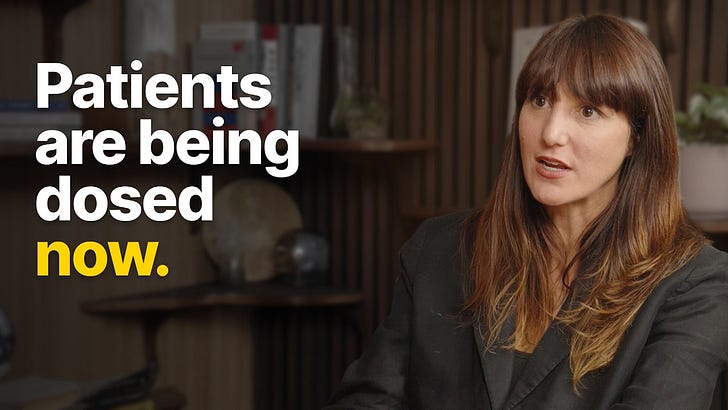
Kris Borer is an entrepreneur, angel investor, and author of the new book Radical Life Extension.
We discuss why Kris rejects incrementalist approaches to radical life extension, and his argument that supplement, lifestyle interventions and small-molecule “geroscience” drugs offer only minor improvements at best to lifespan.
We cover the four part plan to cure aging spanning traditional drugs, advanced bioengineering, tissue/organ replacement, and biostasis (cryopreservation), and we dive deep for the first time on the podcast into replacement: body transplants, lab-grown organs, chimeric organ donors and even... brain replacement.
Resources & Links:
Kris’s Book: Radical Life Extension
Watch on YouTube. Listen on Spotify or Apple Podcasts.
Chapter Markers
0:00 Intro
1:12 Why most longevity bets are too risk averse
12:09 The four approaches to longevity: drugs, bioengineering, replacement & biostasis
17:16 What’s going on with Peptides?
32:04 What is the path forward for replacing organs to extend lifespan?
43:41 What are the limits of Tissue Engineering?
55:46 Biostasis: pausing death until a cure exists
1:03:34 Identity & consciousness: chemo vs. cryo and using AI to upload our minds
1:07:07 Anarcho-capitalism, freedom & the role of government
1:13:24 Closing: pipeline tech & a call to action
Transcript
0:00 Intro
Daniel 00:00:32
Welcome to the Free Radicals Podcast, where we interview the scientists and builders working to dramatically extend human lifespan and bring about a sci-fi future where humanity has full control over biology.
Today’s guest is Kris Borer, author of the brand new book Radical Life Extension, in which he outlines the plan for solving aging. Kris is an entrepreneur with a background in robotics and is an angel investor in many companies working on longevity. Welcome to the podcast, Kris.
Kris Borer 00:00:59
Thanks for inviting me.
Daniel 00:01:01
Thank you for coming on. I’d love if you could share the broad inspiration for the book and the key message of Radical Life Extension.
1:12 Why most longevity bets are too risk averse
Kris Borer 00:01:12
There is an organization called the Longevity Biotech Fellowship (LBF) that you guys know about. We spend a lot of time thinking about longevity and how to make it happen as quickly as possible.
If you attend one of the fellowship retreats, you’ll get all the information you might want about good strategies for building technology to help people live longer and healthier lives. Not everyone can join LBF, so we thought a book might be able to give people a slice of that experience.
It provides an understanding of what we think are the most effective ways to treat aging and help people live longer.
Daniel 00:01:48
Awesome. We had Nathan Chang on the podcast maybe a month or two ago. Eric and I have both been to LBF retreats.
There are a lot of folks in LBF who are listeners to the podcast, but also people who haven’t been able to attend retreats. It will be great to give them a taste of the roadmap for solving aging, which I think we all agree is probably the most important thing in the world to accomplish.
Kris Borer 00:02:16
It’s an exciting time to be alive. There’s so much going on with longevity and a lot to be excited about. But at LBF, we really want to think about whether we can do better and if we are really moving the field forward as quickly as we possibly can.
When we sat back to think about it, we thought we could probably do much better. The reason is that there are many different strategies for treating aging, and not all of them are created equal. There are actually many popular strategies that are quite bad.
One of our goals with LBF is to bring people in, give them a taste of many different areas in the field, and then help them understand that if they really want to make as much difference as possible and save as many people as they can, they should focus less on some strategies and more on others.
To take some extreme examples, you might say we could potentially help people live a lot longer with supplements, and you might start a supplement company. That might be helpful for some people, but for the vast majority, supplements will not make a big difference in how long they live.
On the other end, you might use modern bioengineering technology to change people’s genes, perform genetic editing, and improve human cellular biochemistry so people live a lot longer. That’s much more plausible than supplements, but also much harder.
You actually find a lot of people saying they don’t know how to do genetic engineering, but they do know how to sell supplements. People tend toward things that are easier but lower impact. We want to encourage people to do the hard things that will make a bigger impact in the end.
Daniel 00:03:56
People understand the supplements versus bioengineering angle. I think where people probably get a little more confused, or where there’s more disagreement, is advanced bioengineering for radical life extension versus trying to cure cancer.
Everybody agrees we should cure cancer, and yet curing cancer won’t give us radical life extension. Can you say a bit more about how you focus on what really moves the needle when it comes to lifespan?
Kris Borer 00:04:18
If you cured all cancers, something else would eventually kill you. Curing all cancers gets you a few extra years of lifespan, which is great and something we definitely want to do.
But if we can focus more on aging damage and treat the underlying causes of aging and other chronic conditions of age-related diseases, then we can have a much bigger impact. It’s not that we don’t want to cure cancer; it’s that we want people to focus on underlying mechanisms that could not only cure cancer but cure other chronic conditions as well.
This is probably easiest to understand when you think about the difference between treating aging versus creating longevity drugs like small molecules. A scientist might find some metabolic pathway and see that when someone is young, this pathway is active, but when they are old, it is diminished.
If we design a drug that helps that pathway stay steady, that would be great. That will probably make people who are older feel younger, be healthier, and maybe live a little longer, but it won’t solve aging.
How many of these drugs do you think it would take to make people live to, say, 130? Could you do it with one drug? Can you just tweak AMPK a little bit and make people live that long, or would you need 10, 100, or 1,000?
Eric 00:06:10
The chance that we get anything more than a very modest effect from any one of these molecules currently available is very unlikely. We’re looking at maybe low single-digit lifespan extension from any one of these interventions.
It’s not clear that you would get synergistic effects from stacking them. Let’s say we took five of them and they each give us three years. Ideally, they are all synergistic, resulting in 15 additional years.
Added to an average lifespan of 80, you get to 95. To reach 130, you’re looking for an additional 50 years. By that math, you’re looking for 15 to 20 small molecule interventions at three years each.
Kris Borer 00:06:57
Even if that could work, you should be skeptical of that approach because drugs like that have side effects. Even today, when we give older people three, six, or nine medications, there are drug interactions that cause problems.
You can imagine that if you had 15 or 20 of these drugs to try and get an extra 15 years of life, you may actually be hurting yourself in ways that are hard to predict.
Curing cancer is great and finding drugs that can modulate pathways that change with aging is great, but if you target these things, you are unlikely to have as much of an effect on how long people will ultimately live.
That’s why the Longevity Biotech Fellowship advocates identifying the best strategies for radical life extension—not just a couple of years, but 10, 20, or 50 years—and going hard after those. We don’t want to waste time on things that might only have marginal effect sizes.
Daniel 00:07:58
We’re going to discuss things that can have larger effect sizes, but let’s debate this for a bit. Nobody is claiming—including James Peyer—that his drug will dramatically extend lifespan. I don’t think anyone serious believes that any small molecules currently in the pipeline can significantly extend human life.
Most people expect a step change in the available technology. We need advanced bioengineering. These researchers are trying to find near-term business opportunities that validate the underlying biology and stimulate the pharmaceutical industry’s flywheel toward more advanced therapies.
Is there value in building these small molecule drugs based on the geroscience paradigm? Or is your take that it’s a complete waste of time?
Kris Borer 00:09:09
My take isn’t that controversial, but you have to consider the counterfactual. These drugs definitely add value and will help many people. However, if you choose one path, you might help a lot of people slightly. If you take a path toward radical life extension, you could save people who would otherwise die.
Every dollar devoted to one strategy instead of another represents someone who might or might not reach radical life extension. Simply saying something has value isn’t enough to justify it; you have to consider the opportunity cost.
The opportunity cost of devoting hundreds of millions of dollars to small molecules is quite large. We have identified other strategies with potentially much bigger payoffs.
Daniel 00:10:02
There is a chasm between the niche longevity biotech community and the traditional pharmaceutical industry. Billions of dollars flow into small molecule development, while longevity advocates argue for more investment in areas like cryostasis and replacement therapies.
Small molecules aren’t going away, and the investment there is massive. How do you envision the longevity field influencing traditional pharma? I don’t want to write off the entire industry. How can we leverage their capabilities to further the roadmap outlined in your book?
Kris Borer 00:11:03
The goal is to shift time, attention, and resources toward higher-impact strategies. We aren’t suggesting we abandon small molecules or traditional pharma entirely. If you’re working in pharma, you should focus on things like underlying mechanisms of aging rather than niche issues that aren’t critical for human longevity.
If you have the skills for bioengineering, that might be a better use of your time because the potential impact is much higher. We want to shift people toward these more specialized areas.
Even if the potential impact were the same, current funding levels are vastly different. A marginal dollar going into small molecules won’t make much of a difference, but that same dollar could have a much bigger impact if invested in newer technologies.
12:09 The four approaches to longevity: drugs, bioengineering, replacement & biostasis
Daniel 00:12:10
Let’s get into the specific strategies. This will give people who aren’t familiar with them a sense of how impactful different technologies can be. Can you give us an overview of the four different ways of tackling aging? Then we can dive into the most impactful one first.
Kris Borer 00:12:32
The first category is traditional drugs. You identify a molecular pathway and try to modulate it with a small molecule. Recently, newer techniques for modifying biology have emerged, which we call advanced bioengineering. This includes mRNA therapies and genetic editing.
These techniques are much more powerful. You can do so much more when you treat biology like a computer program and reprogram it. It’s so powerful that we don’t yet know everything possible. In a few decades, we’ll be able to program cells just like computers.
In the meantime, some strategies can have an impact sooner. One is replacement. Common procedures like heart or kidney transplants cure diseases, but they also cure aging in the replaced tissue. If an older person receives a liver from a healthy 20-year-old, that liver will be much younger and healthier.
If you can do that for every tissue in the body, you can rejuvenate someone completely. It’s not that straightforward, but that is the general idea. At the Longevity Biotech Fellowship, we think about who we’re trying to help. It’s not just young people who have time to wait for these therapies to reach the market.
People are dying every day. We want therapies that help people regardless of their age or condition. If you need something right now, the only option is biostasis. I’m happy to go into the details of that whenever you like.
Daniel 00:14:32
I’d like to emphasize that when we think about plans for solving aging, we should compare them to what we have today. Currently, as you get old, there is essentially nothing you can do. We have treatments for specific diseases like cancer, but even if we cure that, you end up dying of something else.
There is no alternative today to the slow, accelerating degradation that leads to death. I’d like to start by talking about replacement. Imagine if you could get a body transplant.
Compare the best medical care available today to having a 20-year-old body. That demonstrates the impact replacement can have. I’d love to hear more about replacement, perhaps starting with the concept of “bodyoids.”
Kris Borer 00:15:47
The best we can do now is lifestyle interventions. If someone has a good diet and exercises, they will probably last longer, but there’s a lot of randomness too. By the time you’re 70, 80, or 90, no matter how much you exercise or diet, your body is going to be damaged from metabolic stress and the insults of regular life.
There is no drug or therapy that can do anything about that. However, if you swapped in a young body, all those problems go away. For those who are not aware, body transplant is a proposed therapy where you don’t just transplant a single organ, but everything below the neck.
If you did this, you would restore the function of all your internal organs. You would also provide a better support system for your brain, which would hopefully help it live much longer as well. While this is currently theoretical, there has been some proof of principle.
There have been studies where researchers attached the circulatory systems of young and old animals. This is called heterochronic parabiosis. When you attach a young animal’s body to an older animal, it actually makes the older animal much younger, healthier, and longer-lived. Conversely, having an old body attached to a young animal makes the young animal sicker and causes it to die faster. Replacing an old body with a new one could have a huge impact on healthspan and lifespan.
17:16 What’s going on with Peptides?
Eric 00:17:16
I’d like to dig into the Overton window and the social discourse gulf between the different groups that are important to this movement. Three categories come to mind: early adopters at the frontier of biohacking, traditional pharma and the medical community, and the broader population.
The traditional medical community and pharma don’t have total buy-in from the broader population, but they likely have more trust than the frontier biohacking community does at this moment.
What does the frontier of bioengineering need to do to shift the Overton window from “death is inevitable and good” to being more open-minded and trusting of the bioengineering community?
Kris Borer 00:18:30
Technology is what is going to convince people. When people see demonstrations of life extension or therapies that make them look or feel younger, they are going to change their minds. All the theorizing we’re doing will convince some people to work on the problem, but for the vast majority of people, it will take technological demonstrations.
Eric 00:18:54
Yeah.
Daniel 00:18:54
Eric, you brought up the Overton window regarding body transplants. Growing clones for those transplants is obviously outside of that window. This is not something being realistically discussed in traditional pharma or biotech circles.
Kris, your contention is that we just have to make progress and show amazing results. If we show a mouse whose lifespan we doubled through a head transplant, people will be amazed. Despite the ethical debates, those technological wins capture people’s attention and allow us to progress from there.
Kris Borer 00:19:42
I don’t think we can jump straight to body transplants, even in animals. People would be creeped out by that, even though it would be a huge technological leap for the medical industry. There’s no way public reception could handle that, and the regulatory response could be quite bad.
However, we don’t have to jump right to it. If we are able to solve the organ shortage, we can make normal transplants much more common. When you increase the supply of transplantable material, progress happens naturally. Right now, we only have a few organs, so we give them to the sickest people.
If we had more organs, we wouldn’t just give young kidneys to people with late-stage chronic kidney disease; we might give them to mid-stage patients as well. If you have unlimited kidneys, why not give them to early-stage patients? Why not give them to people who are simply getting older?
We know their organs are going to fail at some point. There is a natural progression as supply constraints go away where you take a more preventative approach with replacement technology. When you start giving older people young kidneys, livers, or even limbs, people will naturally come around to the idea that replacement is a good way to prevent cancer, metabolic disease, or sarcopenia.
Eric 00:21:10
Yeah.
Daniel 00:21:10
The point is that there are immediate needs for organs under the traditional medical system. You mentioned in your Vitalist Bay talk that there are children in need of liver transplants. Anything we can do to increase access to livers for them is clearly good.
Part of this technological progress will simply be alleviating the immediate organ shortage. From there, we can build toward ever-increasing use cases for such organs.
Kris Borer 00:21:46
Absolutely. Once the supply problem is solved, people will realize that transplants work not just for acute organ disease, but also for aging. That is where we can move toward more advanced solutions.
Again, we don’t have to jump straight to body transplants. We can do multivisceral transplants where you get a new set of internal organs. Even just a new set of legs and arms could be hugely beneficial.
Eric 00:22:13
Another challenge with biotech generally is the first-mover disadvantage. Innovative approaches require clinical trials to achieve mass adoption, but there is a massive barrier to entry for implementing those trials and getting successful results.
How do you think about overcoming that barrier of the first-mover disadvantage when pioneering bioengineering solutions for longevity?
Kris Borer 00:22:59
For more traditional biotech or even the new advanced bioengineering, things will likely be okay because there are so many applications and so much money going into the field. People are going to be pushing those technologies forward regardless of what we do.
One of the benefits of having a large community of people who really want to solve aging is that they are going to do it anyway. Even if it is hard to push radical transplant technology like multivisceral organ transplants through, people want to save their parents and grandparents so badly that they will push forward regardless of the difficulty. For niche areas, it will take the radicals to make it happen.
Daniel 00:23:45
Eric, who told you solving aging would be easy?
Eric 00:23:50
Progress in these niche communities, where people are willing to tinker with their own biology, is an important part of how this movement advances. Let’s not forget that the origin of things like pasteurization, the first antibiotics, and the first set of psychoactive chemicals like LSD and MDMA were all originally derived from chemists and biologists who were considered crazy at the time. They were experimenting on things in dishes and putting them in their bodies to see how they reacted.
Decades later, these things become such a part of the status quo that you would be considered insane to think they didn’t work. There is a long-term shift in Overton windows—a preference cascade that happens after something has been so incontrovertibly proven true that people think you’re crazy for not believing it. But when it’s first happening, it seems insane to even attempt it.
Kris Borer 00:25:07
We need to let a thousand flowers bloom. We need the crazy people to try different things. All that matters is that we take the things that work and push those forward. I am all for people doing self-experimentation if they want to. If it works, great. If not, at least they tried.
Eric 00:25:26
One area where I see this experimentation happening very publicly now is peptides. There has been a huge surge in public interest around non-FDA-approved, gray-market compounded peptides that are purchasable online from various Chinese dealers.
There are a number of social events where people get together for peptide tasting parties to try out substances like BPC-157, sermorelin, or tesamorelin. They experiment to see if these naturally occurring or synthetic peptides might improve their appearance, change their sleep, or potentially increase their lifespan.
What is your view on this movement? What does it say about the broader longevity movement that it is kicking off now in such a big way?
Kris Borer 00:26:36
I guess I’m not that cool; I have not been invited to a peptide tasting party. Have you been to one? Does it work?
Eric 00:26:43
There was a peptide tasting party this past Tuesday that our friend Jeff Tang was hosting, but unfortunately, I could not make it.
Daniel 00:26:54
I’ve been to some peptide tasting parties, but I have not injected or consumed any peptides myself. People seem to have a lot of fun with it, and a lot of my friends love them. Kris, I’m curious to get your take on the peptide craze, even if you haven’t been to the parties.
Kris Borer 00:27:16
I haven’t done much research into peptides. If there is useful stuff there, let’s find it and get it out to people. One of the problems with biohacking is that people are throwing parties instead of conducting clinical trials, so you don’t get much good data. It’s hard to tell what is actually effective.
This is a significant problem for the longevity field because there are so many snake oil hucksters out there claiming that injecting massive doses of vitamin C will make you live forever. We know that is crazy now, but whenever there’s a new technology, people want to try it and find out. I would exercise caution, but everyone should feel free to do whatever they want with their own body.
Daniel 00:28:02
I think there are a lot of good things in people experimenting, and hopefully, we’ll learn from it. However, if it’s not done well, it’s hard to learn from it. It’s great that people care about their health and want to optimize it.
My concern is the same one I have with Bryan Johnson. You’re getting people to care about longevity, but my worry is that you give people a false sense of efficacy. People think that because there are hundreds of peptides to choose from, some combination is going to make them live forever.
It sounds dumb when you say it like that, but I think many people intuitively feel this can meaningfully extend their lifespan. They think this is the next generation of amazing biotech. But there’s no evidence to believe these random things will work. As you say in the book, solving aging is a very tough problem. The odds of randomly stumbling upon the solution at a peptide tasting party are very unlikely.
Kris Borer 00:29:11
It is very unlikely, but this idea has recurred many times throughout history. Ray Kurzweil wrote a book about how he takes 200 supplements to stay young and healthy until the next generation of technology can actually reverse aging.
That is not a totally unreasonable thing to do, but you have to decide for yourself what the benefit is for any particular use of your time and money. Should you spend all your weekends and nights researching peptides, or would you be better off going to the gym and getting some extra cardio?
Right now, we know you can get an extra five to ten years just from lifestyle interventions. Even if peptides work, they might only add a year or two. You might actually be hurting yourself by prioritizing them over proven methods.
Eric 00:30:02
The recent uptick in interest in peptides is related to the broader consumer health movement and a distrust of the traditional medical system. People no longer trust the medical system and medical experts as much as they used to after COVID.
Eric 00:30:28
Millennials have much higher agency regarding taking things into their own hands. There is also a contingent of highly educated, well-off coastal elites who are willing to experiment on themselves.
The results of this will likely be that mostly nothing happens. A small amount of people might perceive some benefit, many will perceive none, and a small number will be seriously harmed.
The biggest innovation here is that the same social mechanisms we saw in the 1980s and 1990s leading up to the internet bubble, the era of computers, and the era of AI are now unfolding in the life sciences. That is really exciting.
Kris Borer 00:31:31
I love that energy and want to help channel it into the most effective solutions. If people have the time, attention, and agency to make a difference for themselves and their families, we should mention that there are other options. They might be harder, but they could have a much bigger impact.
32:04 What is the path forward for replacing organs to extend lifespan?
Daniel 00:31:51
It is a good point that anything that gets people more excited about biohacking and biology is a good thing.
Let’s talk more about replacement because I am very excited about the long-term prospect of body replacement. Although I would prefer bioengineering, replacement is often discussed as a far-off, sci-fi concept, yet there is a ton of progress happening. Organ transplants are done routinely today. Why is this a viable path, and what are the most exciting developments?
Eric 00:32:36
Sure.
Kris Borer 00:32:37
We know from current transplants that you can cure diseases and obtain young, functioning organs and tissues from a donor. Replacement is a cure-all. It is a great therapy for both diseases and aging, but it has downsides because large-scale replacement requires surgery.
For small-scale replacement, you might just get a cell injection. For example, with CAR-T therapies, if you have a degraded immune system, we can engineer new immune cells and inject them to replace your system.
To treat aging on a large scale, you need to replace large volumes of tissue. The risk is that a percentage of people who undergo transplant surgery die as a result of the procedure. It is dangerous to open up your body.
The two problems are building a supply of replacement parts and developing techniques to deliver those parts safely. If we can do that, we have a cure for almost any disease and aging itself.
Whether it is cancer, heart disease from atherosclerosis, or simply being 110 years old, the doctor can use the same technique. If a low-risk drug is available, you take the drug. If not, doctors will have this fallback option.
Daniel 00:34:17
What are the main technologies being developed to alleviate the organ shortage and provide a supply for all these transplants?
Kris Borer 00:34:27
There are several technologies in development. Many people are aware of 3D printing organs, but unfortunately, it doesn’t work very well. We have shifted attention toward more promising science.
Some researchers are looking at xenotransplantation, where you take organs from animals like pigs and give them to people. If you genetically edit the pig, the organs are more tolerable, though they still have problems.
My two favorite approaches are chimerism and tissue constructs. Chimerism involves growing an animal that has human organs. You take an animal at the blastula stage—a very small clump of cells—and genetically edit it so it cannot grow a specific organ, like a kidney.
You then inject normal human cells. Those human cells will grow the kidneys while the pig cells grow the rest of the animal. You can then harvest the human organ for transplant. It is a more advanced version of xenotransplantation.
If you want to go straight for human tissue, you can use bioengineering to grow organs directly in a bioreactor. It would be nice to grow a kidney in a jar, but that doesn’t work well in isolation.
Newer technologies are trying to grow networks of organs together. These are tissue constructs where you take skin cells, hit them with reprogramming factors, and direct them to grow a specific set of organs—like a kidney, heart, lungs, and liver—surrounded by skin.
You put that in a bioreactor and, ideally, a year later you have organs ready for transplant. Ultimately, I think tissue constructs made from human cells will be the technology that solves the organ shortage.
Daniel 00:36:40
The other big piece is the brain. We can potentially replace your organs or your whole body below the neck, but your brain is also aging. That leads to the fascinating topic of partial brain replacement. Can you tell us about that?
Kris Borer 00:36:59
Brain replacement is the hardest problem in replacement. You can’t simply give someone a new brain because that would kill them. The brain is also particularly hard to replace because it is such an integrated network. As you know from your academic background, it is a complex web of neurons, supporting cells, and various structures.
There is currently no concrete solution for brain replacement, though we have ideas for things that might work. In a best-case scenario, we could create cells to inject into a person. These cells would navigate to the brain and swap out old cells for young ones.
These cells would also need to replace the extracellular matrix (ECM), which is a significant challenge we haven’t yet solved. Theoretically, advanced bioengineering could produce cells that swap out both the existing cells and the ECM. I have no idea how long that would take; it could be decades or even a century.
Researchers are exploring more immediate alternatives, such as tissue-level replacement. Jean Hebert famously wrote about this in his book. The process involves silencing a region of the brain, removing that tissue, and growing new tissue in its place. Cells are adept at growing new tissue by following developmental pathways, making this approach seem plausible.
The downside is the requirement for routine brain surgery. You would need to have a portion of your brain replaced fairly often—perhaps every year. This is under development, and while we might find interesting techniques, the process remains complicated.
Some researchers are investigating artificial replacement. Certain parts of the brain are not personalized and do not affect your personality; they simply assist with functions like balance or taste. Theoretically, generic biological or artificial parts could be swapped in, though this technology is still far off.
Daniel 00:38:59
Leaving aside brain replacement, which is clearly very challenging, let’s consider nearer-term organ replacement. A major challenge is that transplantation surgeries are extremely traumatic for the body. Undergoing multiple procedures can be very taxing.
This highlights the benefit of multi-organ or even body transplants, which you discuss in the book. There are cases where a whole set of organs is transplanted at once. This involves fewer connection points and a single surgery, which is a compelling solution.
Kris Borer 00:39:48
The more tissue you can replace per surgery, the better. You get more benefit from younger tissue and reduce the risk of multiple surgeries. I wouldn’t recommend someone replace a kidney and then undergo a separate surgery for a liver.
Currently, up to eight organs can be transplanted simultaneously. In a world of unlimited organs, surgeons could likely develop protocols to replace all internal organs at once quite straightforwardly.
Vascularized tissue allografts, such as arm transplants, are much more difficult because of the complexity of the internal structures. As you mentioned, the connections for internal organs are relatively simple for surgeons, so those will likely come first.
Daniel 00:40:34
This is an exciting roadmap. The technologies we are building could enable a future of common organ transplants, near-term health benefits, and radical lifespan extension.
Another exciting aspect is the lack of unknown scientific questions. Unlike the search for small molecules, where we often don’t know exactly what to target, the replacement roadmap feels more like engineering. Which aspects of this involve unknown science versus straightforward engineering?
Kris Borer 00:41:25
In replacement, the biggest open question is how to grow tissue constructs. We currently have bioreactors that can grow cells from an embryo to a stage about two weeks out. This results in a clump of cells rather than full organs.
We can also rescue late-stage pregnancies by placing a developing animal into a bioreactor to grow to full term. However, there is a gap in technology for the middle stage of development. One challenge is developing ectogenesis technology—a bioreactor that can take a single cell to a fully formed tissue construct with organs large enough for transplantation.
We understand the general process, but there are scientific questions regarding the specific nutrients and conditions required during growth. Our bodies handle this naturally, so we must emulate those conditions sufficiently to ensure organs develop healthily.
Another major scientific question is how to ensure tissue constructs never develop parts of the brain that could constitute a person. Ideally, a tissue construct provides as many replacement parts as possible without developing a brain capable of thought or feeling.
This is a significant ethical barrier. There are techniques for brain knockouts that prevent certain cells from developing. Natural examples like anencephaly show bodies can develop without brains due to genetic defects. We need robust mechanisms to prevent a thinking brain from developing within a tissue construct.
43:41 What are the limits of Tissue Engineering?
Eric 00:43:41
In my prior life, I was a bioengineer and worked in the wet lab for around a decade. I worked specifically on stem cell engineering towards regenerative medicine and tissue engineering.
We are probably two orders of magnitude more immature in the field of tissue engineering relative to small molecule therapies. Small molecules are much more like an engineering problem now. In contrast, we are in the Stone Age of understanding the basics of cell biology in the context of the hierarchy of cells to tissues to full organismal function. We barely understand these things at all.
The reason is mostly that they are unimaginably complex. What gives me a lot of hope is the fact that we can arrive at relatively unsophisticated approaches and get remarkable results. It is a sign that there is a lot of progress to be made in the next decade.
The Yamanaka factor reprogramming approaches are a great example. We threw cocktails of transcription factors at skin cells until they looked like embryonic stem cells. Shockingly, it worked. That is not a sophisticated approach, yet it succeeded.
We have done other things, like throwing various growth factors and transcription factors at embryonic-like cells, and they start to look like other organs. Again, this is not sophisticated, but the fact that it works gives us a sense that we can make progress.
However, it is non-trivial. How do you get the extracellular matrix (ECM) assembled in a way that replicates the native ECM? How do you get cells to not only individually differentiate into the proper cell type, but also cross-communicate with their ECM and each other in a way that is sustainable for decades?
Integrating these tissues with each other and with the rest of the body is a massive challenge. I don’t think we have the first idea of how to do that from first principles, beyond throwing cocktails of factors in the media to make it look a little more like the human body. It still feels very early.
Kris Borer 00:46:07
This is one of the biggest reasons to be confident about replacement. If we had to design tissues and genetic programs from scratch, it would not be feasible.
Fortunately, we don’t have to. We can use existing developmental pathways to grow them in bioreactors. By leveraging the natural processes that have evolved over time, we can create tissue constructs relatively easily. This is a primary reason to be hopeful about this approach.
Daniel 00:46:39
There are a few points here. The field is early in tissue engineering, and yet we’re seeing quick gains. That is reason to be bullish on the rate of progress. There are techniques that outsource a lot of the complicated work to biology itself.
With traditional drug development, anything you give to a human requires extensive work to confirm safety. You have to conduct big, expensive clinical trials. With tissue engineering or any technique to generate organs, it is more like engineering.
You are trying to create the organ elsewhere, and you can see if it is working. The feedback loop is faster because you don’t necessarily need to put it in a human to know it works. If you have successfully created a heart, it is obvious.
Kris Borer 00:47:46
You can see if the heart is beating or if the kidney is producing urine. There should be a faster path to developing these therapies.
You will still want to do trials and ensure safety. However, if you grow an organ from someone’s own cells, and it is immune-matched and functionally equivalent, it should be quite safe.
Daniel 00:48:09
Before we move on from replacement, Eric, I’ll give you a chance to tell us if you think what we said was wrong. You had some disagreement at the beginning, and I want to get it on the table.
Eric 00:48:23
I don’t think it’s disagreement; it’s just my own perspective. I am continuously shocked that anything we do works in biology. There is an inverse relationship where things seem harder the more you learn about the field, yet progress continues at a rate that always surprises me.
I look at the work being done with induced pluripotent stem cells for tissue replacement in Parkinson’s disease, spinal cord injury, and pancreatic islet cell replacement for type 1 diabetes. Remarkable things are happening that feel like they shouldn’t work, yet we have clinical evidence in patients that they are working.
The accelerationists always win. People who are optimistic about progress and constantly pushing for acceleration are the ones who solve problems. Looking at the long arc of history, those people have always been right.
Whatever hesitations I have stem from a sense that I wouldn’t know how to approach it myself right now. But when we have enough people knocking at the door of these problems, someone will figure it out. That has been the case for the entirety of human history. I have no doubt we will figure it out, though I cannot tell you the exact timeline.
Kris Borer 00:50:21
That’s really what LBF is all about. We want everyone pushing as hard as they can to accelerate things. Whatever works is what we will go with.
Daniel 00:50:31
From the outside, someone might hear that replacement can solve aging and think we are insane or believe that it is easy. Drug development is extremely hard. Traditional pharma has accomplished a great deal for humanity, and their work is difficult.
The replacement approach is also extremely hard. That is why we are trying to get more people to work on it. We believe that if this is invested in, it could generate tremendous gains for humanity—potentially much larger than other approaches.
Kris Borer 00:51:23
If it works, the payoff will be much higher than any drug program by far.
Daniel 00:51:29
We don’t know exactly how replacement will work or where we will run into issues. However, we want people to be working on things that could plausibly unlock these incredible benefits.
If you want more healthy years for more people, you should work on the approach that has the best shot at enabling that.
Kris Borer 00:52:02
We want as many shots on goal as possible, but we also want the ones that could potentially have the biggest impact. Go for the three-pointers.
Eric 00:52:11
There is something to be said for a stepwise strategy. Look at historical examples of companies that made incredible advances for humanity by starting with a focused, cash-flow-positive problem.
Google, where Daniel is currently employed, is one example. They started with the problem of PageRank for index search. Others had already invented search, but Google did it much better. That innovation skyrocketed Google above everyone else.
From there, they developed ads and other products, eventually leading to the “Attention Is All You Need” paper from their AI research units. That research is what the entire AI revolution is founded on.
The story is not always as clear as choosing between moonshot or incrementalist work. We need both. Incremental work that is cash-flow positive finances the moonshots. In turn, moonshots lift us beyond the limits that incremental work sets for us as a species.
Kris Borer 00:53:48
Our argument at LBF is that the allocation of resources is currently lopsided. If you look at impact, resources are not equally funded; almost all resources go to low-impact projects. We recommend shifting some of that focus to moonshots and taking bigger swings.
Eric 00:54:14
I couldn’t agree more.
Daniel 00:54:16
With any movement, it is easy to frame it as wanting to tear down the existing system and replace it. For example, in crypto, you hear rhetoric about taking down the banking system and replacing it with the blockchain.
“Down with fiat currency” is a rallying cry that inspires people and creates tension between the establishment and the contrarians. However, the result is usually the construction of a new future.
That new future might replace the establishment or merge with it. Regardless, it pushes progress forward. You need optimists with strong visions to go build things that nobody else is building.
Kris Borer 00:55:30
Absolutely. Replacement might not take us all the way there, but having that additional toolkit is very valuable in combination with traditional drug development or bioengineering solutions. We want doctors to have access to all these different tools when they are trying to keep people alive and healthy.
55:46 Biostasis: pausing death until a cure exists
Daniel 00:55:46
Let’s touch on cryostasis for a bit. It is one of the top things people can do today that can actually increase their odds of achieving radical life extension. Can you tell us about cryostasis—or biostasis more generally?
Kris Borer 00:56:08
Daniel, you and I were both EMTs, so we know that after someone’s heart stops, they’re not actually dead. They might be legally dead, but if you apply CPR or an AED, you might be able to bring them back. Death is a process, not an event.
When someone is very old, doctors might say, “Their heart stopped, let’s give up,” because it wouldn’t make sense to restart their heart only for them to die again from cancer or another underlying condition. But when someone is young, it makes sense to bring them back because they have many years of life ahead of them, and the condition might be treatable.
Biostasis is the same idea. When someone is declared legally dead, let’s give them a chance to be resuscitated when technology exists to treat their underlying condition, whether that’s aging, cancer, or whatever killed them.
This is done using cold temperatures or chemicals to stop molecular motion and pause metabolism. By putting metabolism on pause, the person won’t get any worse over time, and hopefully, at some point in the future, they can be revived and repaired.
Imagine someone who died of a heart attack 100 years ago. Doctors then would say there was nothing they could do. But if that same person had been put on pause in a freezer for 100 years, we could theoretically unfreeze them today and treat the underlying condition that caused their heart to fail.
Today, we face the same situation with untreatable cancers and other diseases. Biostasis gives people a chance to be put on pause and benefit from future medical technology.
In practice, you sign up with a provider. When you’re terminally ill, they pick you up after you die and administer protective medications and antifreeze. They cool you down and place you in a dewar, which is like a big thermos, to keep you safe until future technology is ready to repair you.
It sounds like a wild sci-fi idea, but the technology is actually here. For those who can’t wait 10 to 40 years for replacement or bioengineering solutions, biostasis is a real product you can buy right now.
Daniel 00:58:50
Laura Deming, who has a cryostasis company, frames biostasis as time travel into the future where a cure exists for your disease. The rate of technological progress is so high that new cures are emerging constantly.
There are tragic cases of children who died of leukemia but would have survived if they had been born just a year later. These examples will likely increase as we cure more things faster.
If we unlock real levers for longevity in the next few decades, it would be tragic for people to miss out because they didn’t live long enough. Biostasis can help those people.
Kris Borer 00:59:54
That’s the hope. We want to live in a world where suspended animation is common. We don’t have that yet. Suspended animation is the ability to freeze and unfreeze someone without any damage.
If we had that, the people you mentioned could be put into suspended animation and brought back a year later when a cure is available. Since we don’t yet know how to revive people, all we can do is put them on pause and hope technological progress allows us to unpause and cure them in the future.
Eric 01:00:34
Where do you feel the cryopreservation field is today in terms of readiness? Would you recommend it to a friend who is concerned about having access to the best technology for aging? What is your honest read on the field?
Kris Borer 01:01:02
I’d say anyone who wants to live indefinitely or have a radically long life should sign up for biostasis. The field has made significant progress despite limited funding. In the early days, people were frozen, which caused significant tissue damage.
Putting someone into liquid nitrogen without antifreeze creates ice crystals that kill cells. The modern process, called vitrification, is much more sophisticated. We use a special cryoprotectant so that instead of ice crystals forming, the body essentially turns into a block of glass.
When you vitrify something, there is no ice crystal damage, and theoretically, you could unfreeze them with future technology and all their cells would work. This reduces the amount of repair needed to bring them back.
Biostasis technology is working well enough that people should adopt it. In the future, everyone should have a contract with a provider in case of an accident or disease, allowing them to take a break from life and come back once they can be fixed.
Daniel 01:02:19
Anyone bullish on technological progress should be signed up. Even if the technology isn’t perfect yet, if you believe in progress, eventually we will have the technology to bring you back, regardless of the initial technique used.
Kris Borer 01:02:38
If you’re bullish on technological progress, your bar should be information-theoretic death. Is there enough information for future technology to reconstruct who you are and bring you back to life?
If you are cremated, no information remains for future technology to work with. But if you are frozen and have some ice damage, you can imagine future technology repairing those cells.
I think we’re close to a point where cryoprotectants are good enough that we won’t even need hypothetical future rewarming technology. Animal organs have already been vitrified, warmed up, and implanted into animals, where they work well enough to keep them alive.
A human is larger than an animal organ, making it more difficult, but I think next-generation cryoprotectants will make this a reality quite soon.
1:03:34 Identity & consciousness: chemo vs. cryo and using AI to upload our minds
Daniel 01:03:36
Do you have a strong take on the philosophy of consciousness that applies here? Do we need my exact brain tissue for it to still be me when you revive me?
If you scan my brain and then you bioprint my brain somewhere else, what do you think?
Kris Borer 01:03:53
I do not have a strong philosophical position, except that implicitly I do because I signed up for cryostasis instead of chemopreservation.
If you are cryopreserved, the goal is to warm you back up so that biologically you are the same person. If you are chemopreserved, the goal is to ensure the brain structure is perfectly preserved so that you can transfer the brain to some sort of computer emulation later.
That is good enough for some people. They say if there is an emulation of them running on a computer, they feel like they have survived and they are happy with that.
There is a spectrum in between, but I am more in the camp of wanting to be revived in my own biological body if possible.
Daniel 01:04:40
Now that Eric and I have a bunch of YouTube videos out there, we are going to live on immortally as long as the YouTube data centers exist. So we are good, right?
Kris Borer 01:04:51
There are companies that will collect all your data and make a simulation of you using LLMs. If you think that is good enough, then you are fine. Personally, I do not think that is me, but to each their own.
Daniel 01:05:02
Based on that dichotomy, I am going to choose cryostasis. It feels important to me that it is my brain.
Kris Borer 01:05:11
Well, you are in luck because there are more options for cryopreservation, and you will have the pick of the litter.
Daniel 01:05:19
Would you be willing to share which vendor you use?
Kris Borer 01:05:21
I signed up with Tomorrow Biostasis, but there are lots of good options, so I don’t think people should pick based solely on what I chose.
You should really pick the vendor that has the technology you like and has access to you. A local vendor might be better than a vendor in another country.
Even if the foreign vendor has better technology, you want someone who can get to you quickly. After you are legally dead and your heart stops, damage accumulation accelerates.
During life, you accumulate a lot of damage and your body degrades, but that goes up exponentially after your heart stops. You want someone who will be there very quickly to pick you up and preserve you.
Daniel 01:06:03
How high leverage do you think it would be for the field if regulations were changed so that people could go under cryostasis while they are still alive, rather than waiting for death?
Kris Borer 01:06:15
It would help a lot. Some people are trying to approximate this with medical aid in dying laws—death with dignity.
You may be familiar with the agonal process. When someone is dying, before their heart stops, circulation slows down and cells start to die off. Pre-legal death involves an acceleration of damage, and after legal death, it is even worse.
If you know you are going to die in a week or two and you want the best preservation possible, you could go to a state that allows medical aid in dying. A doctor will give you an injection that you can administer to yourself. You will die quickly while your brain is still healthy.
If you have your cryonics company standing by next to your bedside, they can quickly preserve you and you will get an excellent preservation. If you could start earlier, that would be much better.
1:07:07 Anarcho-capitalism, freedom & the role of government
Daniel 01:07:07
I am going to make a bit of a hard pivot. I saw something interesting in your background; you are not a stranger to contrarian groups. You wrote a previous book, The Ethics of Anarcho-Capitalism.
I would love to hear about your interest in anarcho-capitalism and if it relates in any way to your journey into this field of longevity biotech.
Kris Borer 01:07:34
When I was younger, I was interested in philosophy. I read that people’s personalities change a lot when they are young, but less so when they are older.
I did some research on different views of life, philosophies, and political stances, and I came across libertarianism. I thought it was excellent.
It wasn’t just from an interpersonal perspective—it is nice if people treat each other well—but it seemed like it had huge economic benefits as well. The more libertarian a society is, the more likely it is to produce technology and wealth, and people are happier and healthier.
I liked all that stuff and wrote the book so other people might appreciate it too. While I was writing it, I realized that one of the things libertarians care a lot about is freedom.
Freedom is not just freedom from interpersonal conflict, which is liberty. Liberty is the state where nobody is violating my rights or constraining what I can do.
But there are also constraints from nature. Nature puts constraints on us. If you want total freedom, you need to overcome not just interpersonal constraints that come from governments or criminals, but also constraints that come from the natural world we live in.
Total freedom means building societies that respect rights and also building technology that helps us live as long as we like, fly to the stars, or go into virtual worlds. They are connected under the umbrella of freedom. It is just different kinds of freedom that we are talking about.
Daniel 01:09:15
Eric and I talk a lot on this podcast, especially in our last episode with Jonathan Anomaly, about the liberating power of biology and bioengineering.
We are very constrained by our biology. It is obvious how constrained we are when we suffer from disease. To me, that is the most exciting angle on biology: let’s free ourselves to achieve anything we want in the world.
Similarly, I envision a future where we all get to travel to other planets if we want to, have all the different careers we want to have, and create all the things we want to create to really unleash that full level of human agency.
Kris Borer 01:09:46
Exactly. We are not trying to force any of this on anybody, but we definitely want people to have the option.
Daniel 01:10:12
We are going to force the freedom on you.
Kris Borer 01:10:13
You have got to want it. You are going to live forever whether you want to or not.
Daniel 01:10:22
Eric, are you going to endorse anarcho-capitalism?
Eric 01:10:26
Am I going to endorse anarcho-capitalism? I have to really think about that one.
Overall, entrepreneurship is like a self-restrained, societally sanctioned version of anarcho-capitalism where you are basically allowed to be a cowboy and go build stuff.
If customers believe in you, they buy your product. If investors believe in you, they invest in your company. You can change the way the world works.
It is a little restrained because there are rules around how you can be an entrepreneur that keep you from totally toppling the existing status quo. But generally, I do believe in anarcho-capitalism because I am an entrepreneur and a former VC.
Kris Borer 01:11:18
I love it.
Daniel 01:11:21
It brings up an interesting question I’ve wondered about. I dabbled in anarcho-capitalism in my youth, but I’m more of a libertarian now. I’ve often wondered about the role of government in scientific funding and health.
The government is funding some cool science in this space. I’m curious how you feel about the government’s role in the longevity field. There are ways we can leverage it to our advantage, but is it a bad idea in the long term to rely on government support?
Kris Borer 01:11:57
There are two ways to think about it. One is what an ideal society would look like for generating longevity technology as quickly as possible. That would be a society without government—an anarcho-capitalist or libertarian society where people and companies privately fund scientific initiatives without any government interference.
However, that’s not the world we live in. We live in a world with a lot of government. If we want to save lives with longevity technology, we have to accept that and do whatever we can to divert funding from things that are anti-life or anti-freedom toward things that are pro-longevity.
We should shut down government programs we don’t like and put that money toward longevity research and technology development. I have a great book for you if you’re interested in this kind of thing called The Economic Laws of Scientific Research. It goes into this in detail.
Daniel 01:13:01
I’m going to check it out. That take generally makes sense. If the government has already looted your resources, you might as well try to put them to good use rather than bad use.
Kris Borer 01:13:12
Exactly. No one on this podcast is going to be able to get rid of the government; it’s just a very challenging problem. Even if that is the ideal path, it’s not a realistic path anytime soon.
1:13:24 Closing: pipeline tech & a call to action
Daniel 01:13:22
We have a few more minutes left. Is there anything else we should cover?
Kris Borer 01:13:26
People should be very hopeful and excited about this field. I do a lot of angel investing, and I’ve seen some really incredible technology coming down the pipeline. You talked to Karl Pfleger; he’s a much more prolific angel investor with more information and connections.
A lot of the things he and I have invested in are going to help a lot of people. Hopefully, they will change the trajectory of lives for those who are still around in ten years when these technologies get through clinical trials. It’s a slow and painful process, so on one hand, I’m super excited.
For example, there’s a company called Repair Biotechnologies. I don’t know if you’ve spoken with Reason or anyone from that group, but they have a gene therapy that teaches your cells how to break down excess free cholesterol. If you think statins are good, this is a thousand times better.
They’ve shown in mice and monkeys that this mRNA therapy not only halts the progression of atherosclerotic plaque—like statins do—but actually reverses it. For the first time ever, we have a disease-modifying therapy for the number one killer in the U.S.
With these new genetic engineering techniques, we could potentially start knocking down some of the biggest killers, including different types of cancer. One of the companies I invested in has a cure for four types of cancer. It’s amazing what these new technologies can do.
It’s not out yet because it has to go through all the regulatory hoops, but I am super excited about what’s happening. On the other hand, a lot of the effort is still going to things that will only have a marginal impact. We want to encourage people to join the Longevity Biotech Fellowship, understand the strategies that have been laid out, and move toward higher-impact work.
Daniel 01:15:26
If people are interested in contributing to this space—and I think they should be—there is a lot of infrastructure to help them get into it, such as the Longevity Biotech Fellowship.
There are also investors eager to support it who can’t find enough things to invest in. You would probably love to invest in more talented founders building amazing technologies.
Kris Borer 01:15:52
Absolutely. That is music to my ears. I’ve seen so many pitch decks that are just the same old thing. When I ask how it applies to longevity, they say they are targeting one specific disease, but maybe it would help in certain cases.
I would love to have more young people saying they have a new technology they are applying to longevity to solve aging. That would be fantastic.
Daniel 01:16:16
Kris, thank you for joining us on the Free Radicals Podcast.
Kris Borer 01:16:18
Thank you for having me. It’s been a blast.
Daniel 01:16:20
Thank you for listening to this episode of the Free Radicals Podcast. If you enjoyed this episode and would like to support us, the most helpful thing you can do is share this with a friend who might enjoy it too.
Please also leave us a five-star review on Spotify and Apple Podcasts, and like and subscribe on YouTube. It would really mean a lot. I’m Daniel Shur, and my co-host is Eric Dai. Thanks for listening.