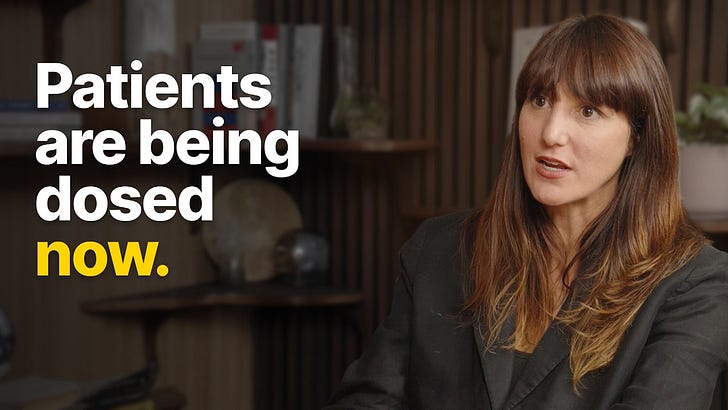
Jonathan Anomaly is a co-founder of Herasight and former PPE professor. Herasight is pioneering polygenic screening for embryos, to help parents undergoing IVF select embryos for health, intelligence, height, and other traits people care about.
Jonathan explains the ethics of embryo selection and how a preference cascade will lead to its normalization, and why that’s good for humanity. We also get into the philosophy of radical life extension and transhumanism, and what a future of total control over biology will look like.
In this conversation, Jonathan espouses a Nietzschean view of humanity. Within each of us we have the opportunity to either envy greatness in others, or seek to cultivate it within ourselves and in the world. As we develop new biological technologies, we will have the opportunity to give ourselves and our children the best life possible, or we can give into envy and tear each other down.
Watch on YouTube. Listen on Spotify or Apple Podcasts.
Chapter Markers
0:00 Selecting embryos for intelligence and the taboo around it
7:39 Aging, death and status quo bias
14:29 Side effects of secularization
17:29 How a preference cascade will shift the Overton Window
22:40 The importance of biological intelligence post-AGI
29:53 In vitro gametogenesis, gene editing & fully synthetic human genomes
38:14 The rift between us and the upcoming enhanced generation
43:26 Nietzsche’s Übermensch, slave morality, and transhumanism
56:32 Longevity as our generation’s space race
Transcript
0:00 Selecting embryos for intelligence and the taboo around it
Daniel 00:00:56
Jonathan Anomaly, welcome to the Free Radicals Podcast.
Jonathan Anomaly 00:00:59
Thanks for having me on. I love the name of the show.
Daniel 00:01:02
Awesome. We love your name, too. Anomaly is a pretty sick name.
Jonathan Anomaly 00:01:05
Dr. Anomaly. I never thought I’d be that, but I changed my name when I was nineteen at Berkeley as an undergrad. I didn’t anticipate being Professor Anomaly or Dr. Anomaly. Everyone thinks it’s a supervillain name, but it’s real.
Eric 00:01:19
That’s so cool.
Daniel 00:01:21
There’s another interesting name: Herasight. Tell us about your company.
Jonathan Anomaly 00:01:26
It’s named after the goddess of family and fertility, Hera. We started about three and a half years ago. The idea was to build on what Genomic Prediction and Orchid had started.
There are a couple of other companies in the space, and we wanted to build the best polygenic predictors in the world. We wanted to go all-in on the traits that people care about and that actually matter for human welfare, which includes IQ.
We wanted to do the thing that we knew would get us in some trouble, but we also knew would be good for humanity. Twenty years from now, this will be considered obviously uncontroversial. That’s what brought us together: value alignment and going all-in on the best science for the traits people actually care about.
Daniel 00:02:23
This brings up an interesting point regarding the difference between expressed and revealed preferences. I think we’ll see this with embryo selection.
You brought up IQ. A lot of people want to deny that intelligence is a real thing that varies. Yet, we have evidence that once people can select for the intelligence of their children, they’re going to do it. Can you tell us about that dynamic?
Jonathan Anomaly 00:02:52
It’s a hypothesis so far because we’ve only served about 140 people. Once we have 10,000, I’ll get back to you with statistics. Anecdotally, there are going to be people who publicly condemn but privately use companies like ours.
This has been made a taboo, especially in the second half of the 20th century. The genetics of intelligence became a taboo as egalitarian political ideals spread after World War II. Since we couldn’t do much about intelligence differences until now besides education and environmental training, people questioned the point of bringing it up.
The fear was that it would allow people to understand they were born a certain way and couldn’t change it. My view is that now you can do something about it for your children. You can influence them through genetic selection and certainly through sperm or egg selection. We are breaking the taboo, and I think we’re going to be thanked for it because for the first time in history, we can do something about this.
Daniel 00:04:23
I’d add that as a society, we constantly see people express preferences for traits like intelligence. People select mates who are more intelligent and have an intuition that their children are likely to be more intelligent as a result. Why is there such a taboo around it despite how it plays out in real life?
Jonathan Anomaly 00:04:56
It goes back to history and the misuse of genetic data to promote certain ideologies. Specifically, the US in the 1920s and 30s and Nazi Germany. It’s almost boring to talk about it at this point because it’s so obvious that’s what happened.
You see it in the data and in the way scientists changed how they spoke about these things. Some of it was for the better, with more talk about tolerance, but some of it was for the worse. In the 1940s, some scientists started bending scientific facts to fit a narrative they wanted to bolster.
They had good intentions, but they ended up setting back their own ideals as well as scientific progress by holding us back from studying the genetics of intelligence. Countries that didn’t participate in the war directly simply don’t have these taboos.
In Singapore or India, they don’t understand why you would deny the trait that literally makes us human. We call ourselves Homo sapiens for a reason; the brain distinguishes us. It’s not just intelligence; it’s social coordination, prosocial behavior, and the ability to plan together.
Intellectuals deny this for political reasons, but people with less education often understand it better. Emily Willoughby from the University of Minnesota wrote a paper on this. She studied people with two or more children and different levels of education.
She found that less education or more children led people toward the correct views on heritability. People who have kids or haven’t absorbed academic taboos simply look around the world and see that traits like personality, athleticism, and musicality are largely out of our control.
You can tune it up with lessons, but parents realize that even if they raise their children the same way, they turn out wildly different. They understand it must be for genetic reasons.
7:39 Aging, death and status quo bias
Daniel 00:07:39
We’re going to dig more into intelligence and embryo selection, but first, I want to get longevity on the table because I think there are similarities around taboos.
We’re very interested in indefinite lifespan extension—treating aging itself as a disease. But that’s a taboo. It’s weird to talk about aging as a disease.
Just like with embryo selection, we can’t do much about aging today. Maybe that’s why people don’t like to think about it as a problem. How do you react to that?
Jonathan Anomaly 00:08:27
That seems like part of it. If you can’t do anything about a problem, there is something negative about constantly dwelling on it. It’s as if you’re advertising your own superiority over other people.
Even if you aren’t superior in a dimension we care about, pointing out differences that can’t be changed makes you look like a bad person. Why constantly harp on these things? For the first time, we might actually be able to do something about it.
The second thing going on is that people have an un-Darwinian view of human nature. I absorbed this early: most people don’t understand what kind of creatures we are or the tentative processes that led to where we are today. They don’t realize how easily things could have been different.
This applies both to longevity and embryo selection. People understand wanting to cure a discrete disease caused by a mutation because it is a clear deviation from the norm. However, they find it creepy or strange to go above the statistical norm, whether that involves lifespan, health, or intelligence.
We are anchored to the status quo. Nick Bostrom and Anders Sandberg have discussed status quo bias in ethics. If you ask people if they want to select an embryo for intelligence or longevity, they are often hesitant.
But if you ask if they would want to select against those things, they say, “Absolutely not.” This suggests they think the statistical average is exactly where we should be. It’s a false, teleological view of human nature, somewhere between an Aristotelian and a Christian perspective.
It is an incorrect view of human nature. For example, David Reich recently published a paper showing genetic selection in favor of cognitive ability in East Asia and Europe over the last few thousand years. This suggests there isn’t one static human nature that has remained unchanged for hundreds of thousands of years.
Selection can be recent, rapid, and can move in all kinds of directions. Ashkenazi Jews, for instance, come from a founder population that was very small in recent European evolution. Because that population was so small, Jews carry various disease-causing mutations alongside potential advantages.
This is how evolution works. The idea that the current average of humanity is “just right” is very strange. Groups vary in many traits, such as lung capacity in Tibet, long-distance running in East Africa, or sprinting in West Africa. Status quo bias is a real bias, and it’s worth recognizing.
My friend Alan Buchanan points out that if you saw a fast-forwarded version of the symptoms of aging in a normal person, you would be horrified. Their skin sags, their bones lose density, their muscles waste away, and their eyes fail. You wouldn’t wish it on your worst enemy.
Yet, this is accepted as the norm. There’s no reason to accept it. This also shows the arbitrariness of the moral line between treatment and enhancement. Do we really want to view the deterioration of our sight and hearing at age 40 or 50 as morally good and normal?
Most people do Botox and other treatments, but they still have this weird view that we shouldn’t mess with things at the genetic level. Why not? Why do we accept this status quo bias?
Daniel 00:13:54
This bias pops up in our decision-making in other ways. When someone has a terminal illness, we’re willing to take much more risk in their care because the alternative is death.
I would argue we’re all terminally ill. We are all going to age and die, yet there is an enormous amount of aversion toward trying anything to treat aging.
14:29 Side effects of secularization
Jonathan Anomaly 00:14:23
Psychologically, it’s interesting to ask why this is true. There are negative side effects to the secularization of society, including a loss of hope. Belief in God and religious structure is beneficial; there’s a reason it evolved universally.
There is a real loss with the decline of religion, but there is also a gain: freedom from the idea that death is not only inevitable but perhaps even good. Some views suggest death is the best thing because it allows you to unite with God.
While religion is compatible with various views on longevity, there is a tendency within religious worldviews to simply accept suffering and death. I reject that. Suffering is part of life, but the beauty of life is using that suffering to overcome challenges and improve ourselves physically and mentally.
It is depressing to think we could be made to suffer with no compensating benefit at the end. One benefit of losing this teleological worldview is the realization that life is in our own hands. We should make the best of it for ourselves and our children.
Daniel 00:15:56
Religion inserts an interesting value function. If you have eternal life in heaven after death, that’s infinitely better than the regular world.
You can make the same argument with longevity. If we crack aging, that is an infinite upside. As an economist, how would you value the possibility of that infinite upside?
Jonathan Anomaly 00:16:21
People value life at different rates. Many are terrified of the prospect of living forever because they imagine they would be forced to live and could never die. However, suicide and accidents will always be a factor.
There is a weird thought experiment involving Groundhog Day. It feels like a curse where you keep living the same life and eventually get bored of everything. Maybe that is true, or maybe we could enhance cognition so that we cannot get bored because there is an infinite possibility of exploring new topics and meeting new people.
I think that worry is in the back of people’s minds. Most people say that if they were ever in a decrepit state, they would want to die. Yet, when they are actually near death, they choose to live longer. They want more time.
If we could picture living a very long time while remaining healthy, almost everyone would opt for it. I do not know how to calculate that value function, but the desire for more time is clear.
17:29 How a preference cascade will shift the Overton Window
Eric 00:17:34
The core theme of our podcast is that we should grant humanity total control over biology. That should be a core tenet of how we invest our resources and talent to build something historic.
Even in the 21st century, it remains an extremely controversial way to view our role in society and our place in the universe. My question is not why this view is so controversial, but how do you operate as a contrarian in a world that not only doesn’t care, but actually actively opposes you in realizing those views?
Jonathan Anomaly 00:18:21
According to the Great Man theory of history, maybe you are the ones who will change these norms. Joseph Henrich discusses this in his book, The Weirdest People in the World, where “WEIRD” stands for Western, Educated, Industrialized, Rich, and Democratic.
His first book, The Secret of Our Success, explores what kind of creatures we are. He argues that elites have always shaped the norms and ideas of the groups they belong to. Most people look for cues of success and leadership and then defer to the behavior, norms, and beliefs of those leaders.
Right now, many people have a status quo bias against radical life extension or genetically improving the prospects of their children. But as elites adopt these new views, the blank slate theory of human nature will melt away.
I think the change will be fast because there will be a price associated with holding false beliefs. The price is your own life or the lives of your children. As this happens, we are going to see really rapid change.
I also want to reference the work of Timur Kuran and his book, Private Truths, Public Lies: The Social Consequences of Preference Falsification. He discusses cases in which you get radical changes in ideology, whether in science or politics.
His favorite example is the fall of communism in 1989. It looked like it would last another 100 years, but it fell immediately. Once enough elites believed communism did not work and realized others felt the same way, it became safe to talk about it. Once a consensus formed among elites, everyone else felt free—and eventually pressured—to change.
The same will be true here. In longevity, I don’t think many of the current “cures” work, but with better research, they will in a decade. With embryo selection, there is no doubt that it works.
As that is better understood, we are going to see a massive preference cascade. Elites will start using longevity medicine and embryo selection, and very quickly, others will feel obligated or pressured to do it too.
Daniel 00:21:28
Regarding longevity, the issue is that there isn’t a product on the market today that can actually extend lifespan. It is a hard problem to solve and requires many people working on it.
If everyone is expressing a preference against longevity, it is difficult to get people to work on it. But if we consider the Great Man theory of history, perhaps all that matters is convincing enough elites to work on it. That may be where the change comes from.
Jonathan Anomaly 00:21:59
I know people in Austin who periodically go to Washington, D.C., to try to influence the administration. If you can get the NIH or grant-making bodies to change their rules or reemphasize what they are funding, you can accelerate progress and change history.
By spreading ideas on an intellectual level, you are contributing to that. Growing this podcast and your other projects is the only way change actually happens.
22:40 The importance of biological intelligence post-AGI
Eric 00:22:42
There are many historical examples where a top-down signaling cascade led society to adopt controversial technologies. We saw this with the move to electricity and the transition from horse-drawn carriages to combustion engines.
What is difficult for people today is that, for the first time, human intellectual supremacy is being challenged by artificial intelligence. That is going to be a tough pill to swallow, even for the smartest elites. We are at a very different juncture in history.
Jonathan Anomaly 00:23:33
I agree. Things have changed so fast that my thoughts haven’t caught up with where we are now. For the longest time, I resisted the idea that AGI is coming.
I know you can’t get AGI from an LLM alone, but it looks like we are actually making progress toward it, and it really is going to change everything. With all the investment dollars flowing into it, this is one of the few hyped-up areas that is probably correctly hyped. It’s not a bubble.
The example you gave of electricity has one disanalogy: electricity was immediately beneficial to everyone. When Ben Franklin invented the lightning rod around the same time electricity was being propagated, there were religious crusades against the technology. People protested, claiming it thwarted God’s will.
The same thing happened with IVF. Fifty years ago, IVF was considered religiously unacceptable. Even secular reporters said it was disgusting and claimed we were creating Frankensteins. Yet, only five years later, public attitudes shifted because elite attitudes changed. That happened for electricity, lightning rods, and IVF. It will be no different here.
Daniel 00:25:09
Tell us why you think AI is going to make embryo selection even more important.
Jonathan Anomaly 00:25:17
I suppose you’re alluding to a thesis I’ve been presenting called “Why Biological Intelligence Matters in a World of Artificial Intelligence.” I’m somewhat ambivalent about this, but I do think biological intelligence will become more important as AI becomes ubiquitous.
There will be more opportunities to use AI to manipulate people politically and financially. Algorithms often embody political and moral commitments that many people aren’t aware of. Even when they aren’t explicitly designed that way, they are trained on human data.
For now, there are areas where we get the answers to relevant questions systematically wrong because of ideology. Sociology is a clear case study. The discipline has been ideologically captured for fifty years, long before the recent wave of wokeism.
When one ideology takes hold of a discipline, it systematically biases the results. If everything published in a discipline is wrong, LLMs will pick up on those errors.
If you aren’t bright or creative enough to ask the right questions or ask the LLM to reflect on its field’s biases, you’ll be a slave to the AI or the person programming it.
There is evidence that brighter people tend to commit fewer logical fallacies and are better at statistical reasoning. Raw general intelligence (G) will be at a premium. However, I’ve backed off from overemphasizing IQ because creativity and personality traits like openness also matter deeply.
The worst person to be in this new world is a bright psychopath or a bright ideologue. Religiosity and political orientation are about 0.4 heritable—moderately so, though less than height or intelligence. We all know smart ideologues who are insufferable.
Nassim Taleb is an interesting example. He is clearly bright and writes good books, but if you disagree with him on certain topics—like the heritability of IQ—he will immediately block you and call you names. He shows that G alone is not enough.
You need intellectual and moral virtues to pursue the truth and overcome bias. This is partly heritable and partly a matter of training. While biological intelligence matters more than ever, the character and mental virtues Aristotle emphasized are also crucial.
Personality traits like intellectual and physical courage are undervalued because they are hard to measure. We don’t have good genome-wide association studies on them yet. One of our funders, an ex-military guy, wants us to look into that.
If we are selecting embryos, we should want personality traits like courage alongside IQ. Even then, you still need to raise and teach your children well. You still need to put them in the right environment.
29:53 In vitro gametogenesis, gene editing & fully synthetic human genomes
Eric 00:29:55
As a bioengineer with a background in stem cell engineering and venture investing at Andreessen Horowitz and Dimension Capital, I’ve seen hundreds of companies at the frontier where life science intersects with technology.
The first, second, and third-order effects of compounding growth in these technologies will completely alter how we view biology and exist as a species.
Today, a company like Heracite or Orchid might focus on single-cell sequencing to determine the genetic orientation of an embryo, typically selecting from about a dozen options.
On the other end of the spectrum, we have technologies that allow you to take a skin cell, turn it into an induced pluripotent stem cell, and then induce that into an egg. There are multiple startup steps.
On the other hand, you have the ability to specifically and selectively engineer sites of that genome using CRISPR-Cas or other genetic engineering technologies. These individual pieces currently operate in largely separate domains, but as these tools become modular and compatible, there will be an explosion of an infinite number of eggs that you can genetically select and engineer.
You can use population-wide statistics to determine the likely traits you are selecting for or against. That future is not far away. What do you think of that scenario, and how far away are we from it?
Jonathan Anomaly 00:31:40
That was the subject of a talk I gave this morning. There will be more convergence in the use of these technologies, but I want to push back because the technical difficulties are interesting.
I have no doubt that embryos will be edited. This already happened in 2018 for a single variant associated with HIV and AIDS. However, editing is often unnecessary if you have In Vitro Gametogenesis (IVG), which allows you to create eggs from stem cells. You can take a skin or blood cell, turn it into induced pluripotent stem cells, and then into eggs.
With enough eggs and embryos, you can deselect for almost any disease without needing to edit. There may be use cases for single-gene editing if you have few embryos before IVG becomes available. But even in 30 years, there is an interesting problem.
If you want to perform multiplex editing on hundreds or thousands of variants for polygenic traits like height, intelligence, and personality, you need to do it at the single-cell stage. There is always a chance for off-target mutations. If that happens, you must wait five days for the embryo to grow, biopsy the outer layer, and check the results.
You would need to whole-genome sequence the embryo to see if you introduced undesirable mutations. If you have high-quality polygenic scores and IVG, you almost don’t need editing. Polygenic screening and editing are rival technologies. For screening, you wait until the embryo is a few days old, biopsy it, and sequence it.
Unless editing becomes extremely precise, you won’t want to edit a five-day-old embryo because it already contains 150 cells. You would have to perform thousands of edits on every single cell and ensure there were no off-targets.
My previous view was naive. I thought we would combine polygenic scores with IVG and then “spell check” the results with CRISPR. It is likely not that simple. These are strangely rivalrous technologies, but it almost doesn’t matter.
If you have a large pool of embryos and good polygenic scores, you already get massive gains without editing. Conversely, if editing becomes safe and precise, you could use it without screening.
Daniel 00:35:32
There is an alternative potential end-state technology: writing the whole genome from scratch.
Jonathan Anomaly 00:35:38
That is how I ended my talk today: synthetic genomes. I have no expertise in this, but I first read the idea from the late Craig Venter. He recently passed away and was a frequent visitor here at SynBioBeta.
He created a synthetic genome and inserted it into a bacterium. He famously called it the first form of life with a computer as a parent because it involved stringing together amino acids to create a synthetic genome.
A friend at the Broad Institute thinks this will happen before widespread gene editing because it might be safer. AI and AI-guided robots will likely play a significant role. If we can do this safely, there is no point in going through complex biological processes and editing while worrying about off-targets. We could simply string together amino acids that resemble a better version of you or your partner.
The distinction between treatment and enhancement is morally misguided and scientifically incorrect. We deal with statistical averages, and there is no reason to believe the current average is a moral or scientific ideal. As a species, we are always changing.
If we take a model of ourselves or others—a kind of von Neumann—we have a sense of what we could be if we were better. We know our deficits, whether it is being too narcissistic, too short, or even pathologically altruistic.
In the next 20 to 40 years, once we understand the genetic architecture of these traits, we will be able to build better versions of ourselves. I have no doubt that is coming.
38:14 The rift between us and the upcoming enhanced generation
Daniel 00:38:17
What happens if the next generation is enhanced to be far more intelligent than us and no longer suffers from aging?
Jonathan Anomaly 00:38:28
Where is the downside?
Eric 00:38:30
That sounds great.
Daniel 00:38:33
But what happens to our generation? That seems like a more plausible future than one where we cure aging for ourselves, but it also doesn’t seem like a stable future.
Eric 00:38:48
That’s the plot of Gattaca, right?
Daniel 00:38:51
Gattaca is different because while you have the haves and the have-nots—those who are enhanced and those who aren’t—the enhanced individuals still die.
It would be great if we could give eternal life to another generation, but I don’t know what that world would be like where we’re all doomed to die while the next generation isn’t.
Jonathan Anomaly 00:39:13
I have a couple of replies to that. First, in the direction you’re gesturing at, I don’t think we’re going to have a step where we go from dying at an average age of 82 to living forever. I don’t know if we’ll ever live forever, but I think there will be incremental changes in how long we can live and how long different organs function.
Neurogenesis is important. We don’t want to live a long time but be basically brain dead. There are going to be different technologies that slowly lead to longer, better lives. I don’t think we’re going to see a sudden divide between immortals and mortals.
Similarly, with enhancement of traits like intelligence—which we discuss frequently because it’s a sexy trait—or a better functioning immune system, it won’t be a sudden jump. It will be incremental. First, we might have immuno-enhancement against the flu virus, and maybe eventually all viruses. George Church has discussed this possibility. You still have bacteria and other issues, so we’re going to get increments rather than the dramatic steps you mentioned.
Secondly, I like to think about this in the way my friend Diana Fleischman does. She has had two natural children and now hopes to use selection for future children. She wondered what she would tell her selected kids who have all these advantages.
There isn’t actually much to tell them because they won’t be that different—perhaps a few extra IQ points or slightly better immunity. But consider a parent in 1950 whose first children were not vaccinated because the polio vaccine didn’t exist, while their second set of kids was vaccinated.
Do you withhold a vaccine and risk your children dying or being disfigured just to honor the first set of kids? Nobody thinks that. You want to give your children every advantage they can have. The same will be true here.
We might envy those future people, and that envy would be justified. It would suck to be part of the last generation doomed to certain limitations. On the other hand, if we aren’t narcissistic, we should be proud of them.
One of the great things about civilization is that humans are the only animals that care about more than just immediate relatives. George Price solved the riddle of altruism at a genetic level across all species with the Price equation. When asked if he would sacrifice his life for a brother, he famously joked, “No, but I’d gladly do it for two brothers or eight cousins.”
That is the evolutionary math of how species should allocate their altruism, but in fact, we don’t do that. We are far more altruistic than that as a species. I don’t know of any other species that are. Some help non-kin, but we are remarkable in the extent to which we do so.
It’s common to see someone help a stranger when they have reason to believe nobody is looking. We see simple acts like someone holding a door for a person in a wheelchair. While some people might do it to impress a date, there are countless unremarkable cases where we make sacrifices for people to whom we have no genetic relationship.
That is a beautiful thing about human beings, and I think we should enhance it. It gives us the capacity to build a church that takes three generations to complete. I was just in Spain and saw one of those churches. It took that long, and what a beautiful thing it was.
We have had that capacity for a long time. I think we will be envious of the people who come after us with capacities we lack, but we will also realize how cool it is that we were a part of creating that.
43:26 Nietzsche’s Übermensch, slave morality, and transhumanism
I include a quote from Nietzsche at the beginning of my book from Thus Spoke Zarathustra. He talks about the Superman and the “last man.” The Superman represents overcoming our pathetic beginnings, both culturally and biologically.
Nietzsche says, “Man is a rope stretched between beast and Superman, a rope over an abyss.” In that scene, a tightrope walker moves toward the Superman while the common man tells him to come back to a life of comfort. That’s the “last man”—the person who could have it all but strives only for comfort and equality.
In Nietzsche’s view, equality is not what we should be striving for. We should be striving to overcome ourselves and our prejudices. I think there is something to this beautiful vision where we can take part in creating something better than ourselves.
That is a huge part of my life. Being part of Herasight is interesting to me because if I can help people have children with a much lower disease burden who will live longer, healthier lives, I wouldn’t even care if I never had kids myself. I would be proud of that.
That is a sincere belief. Human beings have been acting that way for a long time at a cultural level, and we should embrace it as the best part of our nature. We all have the drive to be the best version of ourselves, have the best kids we can, and create technology and institutions that allow the best of humanity to flourish.
There is something beautiful about that. Nietzsche also said that life has an essentially aesthetic justification. In a post-religious worldview, the question of why we are here is the only one that matters.
In half a trillion years, there will likely be no life left in this region of the universe. Why do we go on at all? It is to create something beautiful and interesting.
When I look at those future people who are better in every way than me, I’ll wish I was one of them, but I’m not going to be the “last man.” I’m not going to tear them down just because I don’t have the capacity to be like them.
Eric 00:46:49
I like that.
Jonathan Anomaly 00:46:50
That’s great.
Eric 00:46:51
Where should we take the conversation?
Daniel 00:46:56
That was a lot to respond to.
Eric 00:46:59
Let’s talk about Nietzsche. A core concept of his philosophy is the Übermensch. While I am not a Nietzsche expert, from what I understand of his texts, the core idea of the Übermensch is not necessarily a physically superior being like the Superman from comic books.
Instead, it is a cultural, psychological, and spiritual overcoming of the shackles that society has placed on humanity.
Jonathan Anomaly 00:47:28
I think that’s exactly right. There is a small extent to which it is a biological conception. Nietzsche was reading history and thinking about the future, considering the Aryan invasions of India and these proto-Indo-Aryans.
He called them the “blonde beast,” which he both reviled and upheld as a superior type. He reviled it because, although he was German, he hated the ultra-nationalism of Germany at the time.
He saw firsthand the damage that the Franco-Germanic War caused and witnessed the rise of antisemitism. Some of his last words were, “I’d like to have all antisemites shot.”
He hated this and saw that it could be misused to justify a purely biological conception of the Superman. Indeed, his sister became a proto-Nazi, and Hitler selectively quoted Nietzsche’s discussions of the blonde beast asserting his will on Europe.
Nietzsche is partly responsible for some of that, and there is some truth to the biological component, but the vast majority of what he meant was a spiritual overcoming.
His view was that there was an assertiveness to the horse-riding Proto-Indo-Europeans who made their way across Iran, the Middle East, and Germanic countries. They asserted their worldview on the people they encountered.
The Greeks, Iranians, and Scandinavians inherited their culture, myths, and gods. He saw these as great men to be praised because they didn’t focus on equality or respecting all cultures equally; they simply asserted themselves in the world.
He liked that quality. It is not a view that says we should go around dominating everyone, but it is the view that when Christianity came to Rome, it essentially castrated the European man.
Nietzsche believed Christianity had some beneficial, civilizing effects, especially on the Vikings. It pacified them and made certain projects associated with beauty possible, such as the great churches and the culture Europe created.
The Renaissance was partly a Christian phenomenon and partly a rebellion against Christianity—a revival of Greco-Roman ideals. Nietzsche had an ambivalent view where Christianity castrates Europe but also provides beneficial effects.
He wondered what would happen next, noting that Darwin and others before him had effectively killed God. In Thus Spoke Zarathustra, when he proclaims “God is dead,” he means this as a purely cultural phenomenon.
He was an atheist, but he had no reason to evangelize atheism. He wasn’t like Richard Dawkins; he believed this was one of the greatest crises humanity would face.
He prophesied that Europe would lose Christianity but fail to reassert ancient Greek ideals. Instead, he worried it would adopt the worst parts of Christianity—an obsession with equality and “slave morality.”
In slave morality, you take the people who have enslaved you and rebel by saying all their virtues are actually vices. You then claim your own vices, such as the total impotence to do what you want with your life, are virtues.
In this framework, God rewards the impotent and punishes the able. This is why Nietzsche’s ultimate worry was that Europe would become a nation of “last men.” Instead, he believed we could become the Superman.
He didn’t mean this only for Europe, but he was writing as a European in the context of Christianity’s decline. These ideas were taken up in the early 20th century in both cultural and biological forms.
I always cite George Bernard Shaw’s 1903 play, Man and Superman. He was the first person to translate the term “Übermensch” into “Superman.” Shaw shared Nietzsche’s ideal that we need to biologically and spiritually overcome the shackles holding us back.
There are many ways to conceptualize the Superman, but it stands in contrast to the parts of our nature driven by envy. It rejects the sense that if I can’t have it, nobody can.
It is a rejection of the desire to tear down anyone smarter, more beautiful, or more capable. Instead, we should recognize that beauty and try to foster it. That is the vision of the Superman.
Daniel 00:53:03
That is a fascinating vision.
Eric 00:53:04
Do you think there is a subculture that espouses those views? I would argue that the vast majority of society has gone in the other direction toward slave morality, impotence, and a crabs-in-a-bucket mentality.
Where do you find subsets of people who embody what you might argue is the best of humanity?
Jonathan Anomaly 00:53:26
Nietzsche’s prophecies clearly came true, taking about a century longer than he anticipated. He saw this starting in the 1880s in Europe. Secularization was beginning, and an extreme secular, progressive view was starting to take hold on the other side. It took a long time to manifest fully, but if you look at the modern academy, it embodies the worst ideals in humanity.
I’m not talking about the chemistry department; I’m talking about social studies and philosophy. These fields are supposed to be liberating. They are meant to empower the individual to think for himself, overcome bias, and study humanity as it is. Instead, they have become the opposite. It is slave morality embodied.
Leaving the University of Pennsylvania was the best decision I’ve ever made. You have to leave rotten institutions behind in order to build new ones. While capable people can still navigate academia and get something out of it—especially in the sciences—we ultimately have to throw off those shackles. We need to ask: What are the true ideals? What are the beautiful things?
I always advocate reading old books. Even something just 100 years old, like The Genetical Theory of Natural Selection by Ronald Fisher, is a revelation. Fisher was the inventor of modern statistical genetics; he is essentially Darwin personified statistically. He developed the theories of runaway selection and sexual selection, among many other things.
The last third of that book explores man’s genetic fate. Fisher considers which genetic traits modern liberal society selects for, and his view is quite grim. Whether you agree with him or not, reading someone like Ronald Fisher or Charles Darwin’s Descent of Man allows you to think in radically different ways than a modern education in biology.
While you should learn about cell biology and genetics, reading these classic books makes you realize how much we are shackled by modern norms imposed by progressive liberalism. Some of those norms, like radical toleration, might be positive, but modern academics and journalists often function to constrain thought. We need to break away from that to achieve what we are truly capable of achieving.
56:32 Longevity as our generation’s space race
Daniel 00:56:34
I’ll tie this back to the mission of this podcast. When Eric Dai and I were discussing our goals, we talked about eras of humanity that strove for something great. During the space race, every person could look at the moon and imagine humans up there, traveling into the stars.
When you look at our culture today, you don’t see that same optimism or enthusiasm about the future. Instead, there is a “crabs in a bucket” mentality.
We view longevity and biotech as a way of creating the humans of the future. To me, longevity could be the space race of our time. It is a way for us all to unite toward bringing real beauty and greatness into the world.
Jonathan Anomaly 00:57:32
I totally agree. It is not only important but necessary to have a transcendent goal. Even if traditional religion is on the wane, there can still be a kind of spirituality or ethics in the Greek sense—a set of values to embody and strive toward.
The point you made is fascinating. We are about to head back to the moon and likely to Mars soon. Yet, how much media coverage does that get compared to the stock market’s reaction to the Strait of Hormuz being temporarily shut down?
That gives you a sense of where the average person’s mind is. People are focused on whether their 401k will go up or down by a percent or two this week. I’m not saying people shouldn’t care about financial security; we all need that as a means to an end. But it has become a dull end in itself.
Nietzsche called this the “religion of comfort,” and there is nothing more contemptible. We need something to strive for. That is exactly the spirit you guys embody.
Daniel 00:58:48
Thinking about these grand ideals makes you see all of life differently. After spending the last few days having conversations about the future of humanity and technologies that can help so many people, petty behavior seems insignificant.
We live in an incredible world. There are real dangers facing humanity that we need to work together to fight against, but there is also an amazing future available to us. How can we get caught up in petty nonsense?
Jonathan Anomaly 00:59:20
That is so true. I try to avoid that on Twitter. I don’t really tweet; I just repost updates from my company. However, there are troublemakers at sophisticated universities who just want to poke holes in what we are doing.
Pushback and skepticism are necessary for science to improve its methods, but that isn’t their goal. They are just trying to discredit us, even though we are the most rigorous company offering these services. We make our validation studies publicly available.
These people are like bullies on a playground. They try to bring your aspirations down. In some ways, it’s best to ignore them and “not feed the trolls.” In another way, it’s helpful to recognize them as an anti-ideal.
You don’t want to be a petty person who tears down what others are creating, especially when those creations are beautiful and transcendent. It’s best to view them as a negative example that reminds you to wake up every morning with a renewed sense of optimism.
Daniel 01:00:44
We’ve got one minute left. Is there anything else you’d like to leave our audience with?
Jonathan Anomaly 01:00:47
I’m not very good at promoting my company, so I suppose I should probably do that.
Daniel 01:00:53
Yeah.
Jonathan Anomaly 01:00:53
If anyone is interested in learning more about in vitro fertilization and polygenic scores, whether you’re having a kid or investing in a company, we are always looking for value-aligned investors.
This is an underexplored area. People like Brian Armstrong constantly tweet about editing, which is important, and we need more research there, but I don’t think many people realize how powerful polygenic scores are right now. In the near future, they are only going to get better.
For example, we recently got access to East Asian biobanks. For the first time, East Asians might actually have the advantage over Europeans in terms of the predictive power of various polygenic predictors. This is simply a function of data. If we have more genetically sequenced people in biobanks with well-phenotyped traits, we can create better predictors.
This technology is really under-discussed. Because it is so new, some people don’t realize that we are going to increasingly use polygenic scores. I call it the polygenic revolution.
It won’t just guide embryo selection, which is already very powerful; it will tell us more about history and ourselves. David Reich recently published a paper on this. We can understand ancient humans by looking at polygenic scores rather than just single genes or bones.
We can determine how prone ancient populations were to diabetes or how tall they were. While those traits are partly a function of diet, we can use polygenic scores to determine if they were taller on average or had denser bones. We can see when these changes happened through introgression or mate selection. This is incredibly interesting.
We are going to use polygenic scores to improve our children and to explain the past. In your case, because you focus on longevity, we can use them to guide medical diagnoses and tailor medicine.
To be fair, polygenic scores right now generally aren’t good enough for definitive medical diagnoses, but they are only going to get better and can point you in the right direction. My aunt recently started losing her memory, and she almost certainly has Alzheimer’s. To investigate, we sequenced her and found she has the APOE4 variant, which is associated with Alzheimer’s.
I think we’re going to use this more and more to diagnose and eventually cater medical regimens to that information. What’s going on right now is wildly interesting.
People have this idea in their mind that we could radically transform ourselves through gene editing very soon. I’m not so sure. I hope that’s true, but they are ignoring the elephant in the room, which is polygenic embryo selection and polygenic scores more broadly.
Daniel 01:04:17
Jonathan Anomaly, thank you for joining us on the Free Radicals Podcast.
Jonathan Anomaly 01:04:20
Thank you. It’s been great.
Daniel 01:04:21
Thank you.